
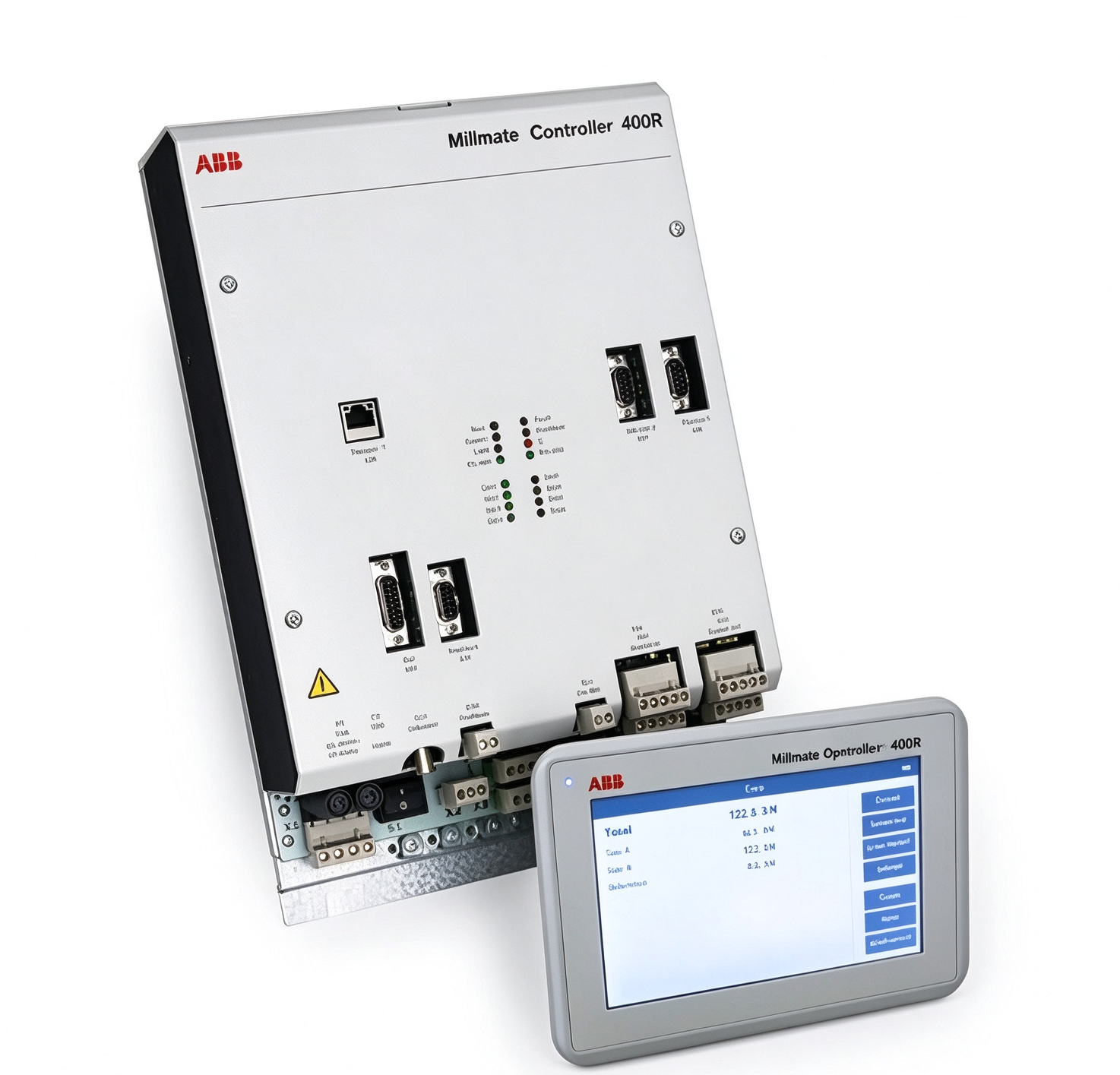
ABB MC400P Millmate Controller 400
The ABB MC400P designation is associated with an industrial measurement controller identification that should be confirmed against the complete product label and applicable technical documentation. ABB’s Millmate Controller 400 family is designed for force and strip tension measurement in rolling mills and material-processing lines. The controller processes signals from compatible load cells and communicates measurement results to connected automation equipment.
Product Overview
Accurate force and tension measurement is important in industrial processes where material forces influence product quality, machine operation, and production stability. In rolling mills and continuous processing lines, measurement equipment must convert sensor signals into useful process values that can be monitored by operators or transferred to a control system.
ABB Millmate Controller 400 is a measurement-control platform developed for these applications. Its documented functions include configurable measurement modes, built-in load cell tables, selectable measurement units, signal filtering, and diagnostic functions. The controller uses the selected configuration and sensor information to calculate the required measurement value.
The MC 400 family includes configurations for different measurement applications. Depending on the model, the system may be used for rolling force measurement or strip tension measurement. The appropriate controller must match the mechanical arrangement, connected sensors, and requirements of the installed production line.
Because the exact relationship between the designation MC400P and the documented PFVA401 or PFCA401 models has not been confirmed, family-level specifications should not automatically be treated as guaranteed specifications for every MC400P unit. The complete order number and product label should be checked before replacement or installation.
Measurement and Signal Processing
The Millmate Controller 400 receives measurement signals from compatible load cells and processes the incoming data according to the selected application configuration. It then makes the calculated results available through supported display, analog, digital, or communication interfaces.
In force measurement applications, the controller supports the interpretation of load cell signals for the installed mechanical arrangement. In strip tension applications, it uses the configured measurement setup to calculate the relevant tension value. The result depends on sensor compatibility, mechanical installation, configuration parameters, and calibration.
ABB documentation describes predefined measurement modes and built-in load cell tables intended to simplify configuration. These features help engineers select settings that correspond to supported sensor and mechanical arrangements. Correct selection is essential because a configuration intended for a different load cell or installation may produce inaccurate measurement results.
Signal filtering is another important feature of the MC 400 family. Filtering can help reduce unwanted variation in measurement signals, but the selected filter time must suit the process dynamics. Excessive filtering can delay the response to changing forces, while insufficient filtering may allow unwanted signal fluctuations to affect the displayed or transmitted value.
Analog and Digital Interfaces
Industrial measurement controllers commonly exchange data with PLCs, operator interfaces, and other automation equipment. The documented Millmate Controller 400 family provides configurable analog and digital interfaces for supported measurement and control functions.
Depending on the model, analog inputs can receive compatible measurement or reference signals, while analog outputs can provide calculated values to external equipment. ABB documentation for models in the MC 400 family lists voltage and current signal options, including 0 to ±10 V, 0 to ±20 mA, and 4 to 20 mA. These ranges must be checked against the exact hardware version and its wiring documentation.
Digital inputs and outputs support discrete control and status signals. The documented family includes 0/+24 V digital interfaces arranged in insulated groups. The precise channel availability, electrical characteristics, and terminal assignments depend on the applicable model.
When connecting the controller to an existing automation system, verify signal type, polarity, scaling, electrical isolation, and common-reference requirements. The controller configuration must match the receiving equipment so that process values are interpreted correctly.
Communication and Automation Integration
The Millmate Controller 400 family can operate as part of a larger industrial automation architecture. Measurement results may be displayed locally, provided through analog outputs, or transferred to other systems using supported communication interfaces.
ABB’s documentation describes serial interfaces, Ethernet communication using the Vendor Internet Protocol (VIP), and optional high-speed PROFIBUS for applicable configurations. These interfaces can support communication with external displays, other Millmate units, or compatible control systems.
Communication options should be verified before a controller is selected for an installation. A function described for the product family may require a particular hardware version or optional interface. The presence of Ethernet or PROFIBUS on a related model does not prove that the same interface is installed on every MC400P unit.
During system integration, engineers should check the communication protocol, addressing, configured data, software compatibility, and expected update behavior. Any change to an operating control network should follow the site’s approved maintenance and configuration-management procedures.
Configuration and Commissioning
Correct commissioning begins with identifying the exact controller and its intended measurement application. Before configuration, confirm the connected load cell type, mechanical arrangement, required measurement units, signal connections, and applicable product documentation.
Predefined measurement modes and built-in load cell tables can simplify setup on supported MC 400 configurations. However, engineers must select the settings that correspond to the actual installation. The selected sensor information and mechanical parameters should be checked against the equipment records rather than copied without verification from a different system.
After the hardware has been connected, verify that the controller receives plausible sensor signals and that the configured units and scaling are correct. Compare local measurements with values received by the connected automation system where applicable. If an external display or supervisory application is used, confirm that the data is transferred and interpreted correctly.
Commissioning should also include review of the available diagnostic functions and any required calibration procedure. Follow the instructions for the exact installed model, particularly when replacing an older controller with a different hardware revision or configuration.
Diagnostics and Troubleshooting
The Millmate Controller 400 family includes diagnostic functions intended to support system monitoring and fault investigation. Documented features include self-diagnostic testing and sensor or transducer testing for applicable configurations.
If measurement values become unstable or appear incorrect, begin by reviewing the operating conditions and the measurement chain. Check the mechanical installation, sensor connections, cable condition, configured measurement mode, and load cell data. Also verify the selected units, filtering settings, and signal scaling.
If the controller’s local value differs from the value displayed by another system, inspect the signal interface and communication configuration. Incorrect scaling, incompatible signal ranges, unit mismatches, or communication settings can create differences even when the sensor itself is operating normally.
Do not assume that every measurement fault indicates controller failure. A systematic diagnostic procedure should distinguish between sensor, wiring, configuration, communication, and hardware issues. Record any alarms, observed values, and corrective actions to support future maintenance.
Installation and Maintenance Considerations
Before installing or replacing an MC400P unit, record the complete product designation, order number, hardware identification, and existing connection arrangement. Confirm the exact model using the equipment label and applicable ABB documentation. Model similarity alone is not sufficient evidence that two controllers are interchangeable.
Installation should be performed by qualified personnel familiar with the equipment and the plant’s safety procedures. Follow the manufacturer’s requirements for mounting, electrical isolation, grounding, wiring, environmental conditions, and commissioning. Do not change connections or remove hardware from an operating system unless the approved procedure permits the action.
Maintenance records should include wiring diagrams, configuration backups, calibration information, connected sensor types, communication settings, and replacement history. Keeping these records current makes it easier to identify the correct spare part and restore the intended measurement configuration.
When replacing a controller, confirm that the new unit supports the required measurement application and interfaces. Any differences in hardware, firmware, optional communication features, or sensor compatibility should be resolved before the system is returned to service.
Industrial Applications
ABB Millmate Controller 400 systems are used in industrial measurement applications associated with rolling mills and continuous material-processing lines. Depending on the controller variant, the application may involve rolling force measurement or strip tension measurement.
Measurement results can help operators monitor material forces, identify abnormal process conditions, and provide data to compatible automation systems. The controller’s effectiveness depends on the suitability of the sensor arrangement, correct configuration, reliable signal connections, and proper integration with the production-line control architecture.
For spare-parts planning, it is important to distinguish between controllers intended for different measurement functions. The exact model and order number should be confirmed before selecting a replacement for an existing installation.
Conclusion
ABB Millmate Controller 400 is a measurement-control platform designed to process load cell signals and communicate force or tension measurement results to other systems. Documented family capabilities include configurable measurement modes, load cell tables, analog and digital interfaces, diagnostic functions, serial communication, Ethernet-based VIP communication, and optional PROFIBUS on supported configurations.
The exact technical identity of ABB MC400P should be verified against the complete product label and the applicable ABB documentation. Confirming the hardware variant, measurement application, sensor compatibility, and available interfaces is essential before publishing model-specific specifications or selecting a replacement unit.
评价
目前还没有评价