
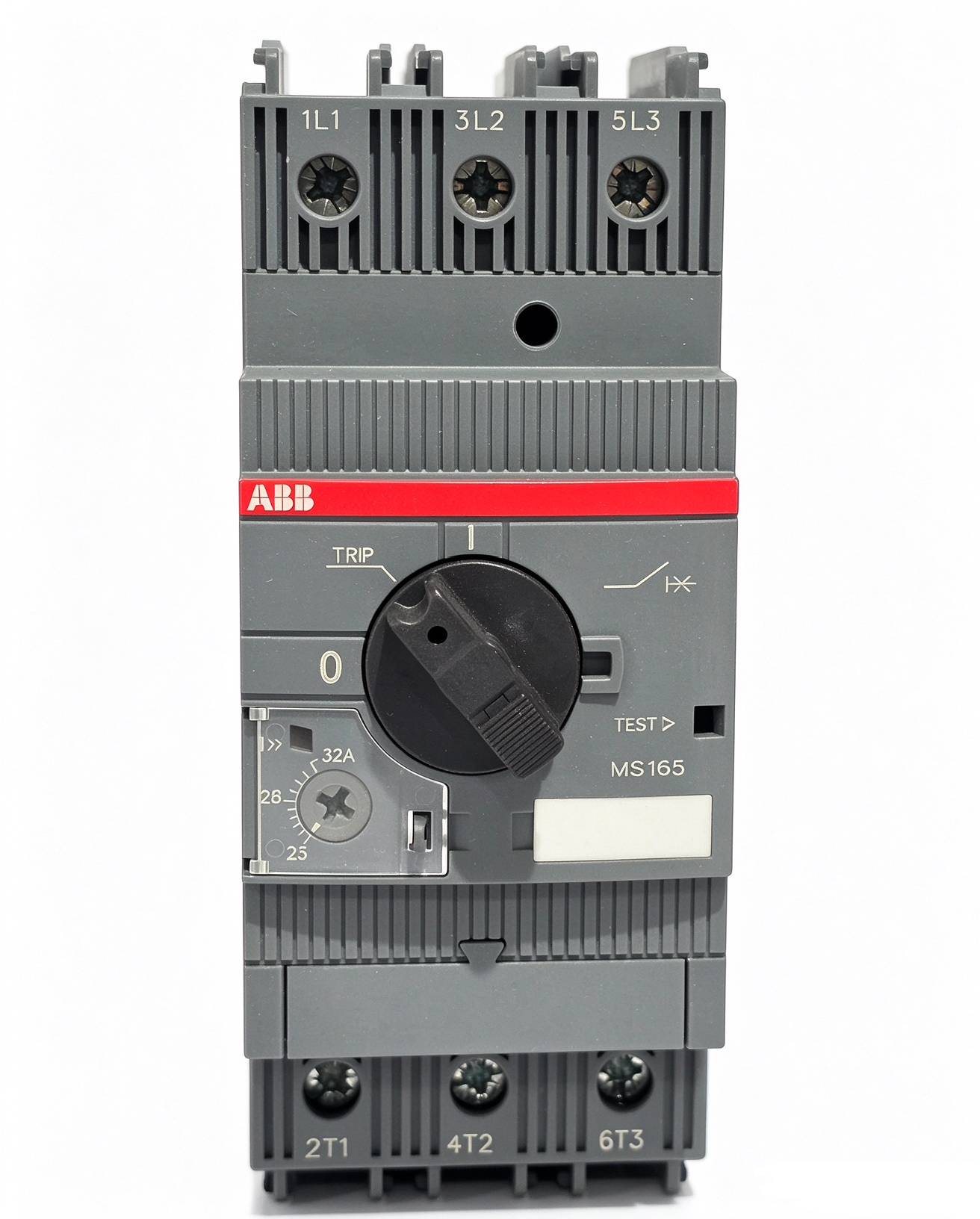
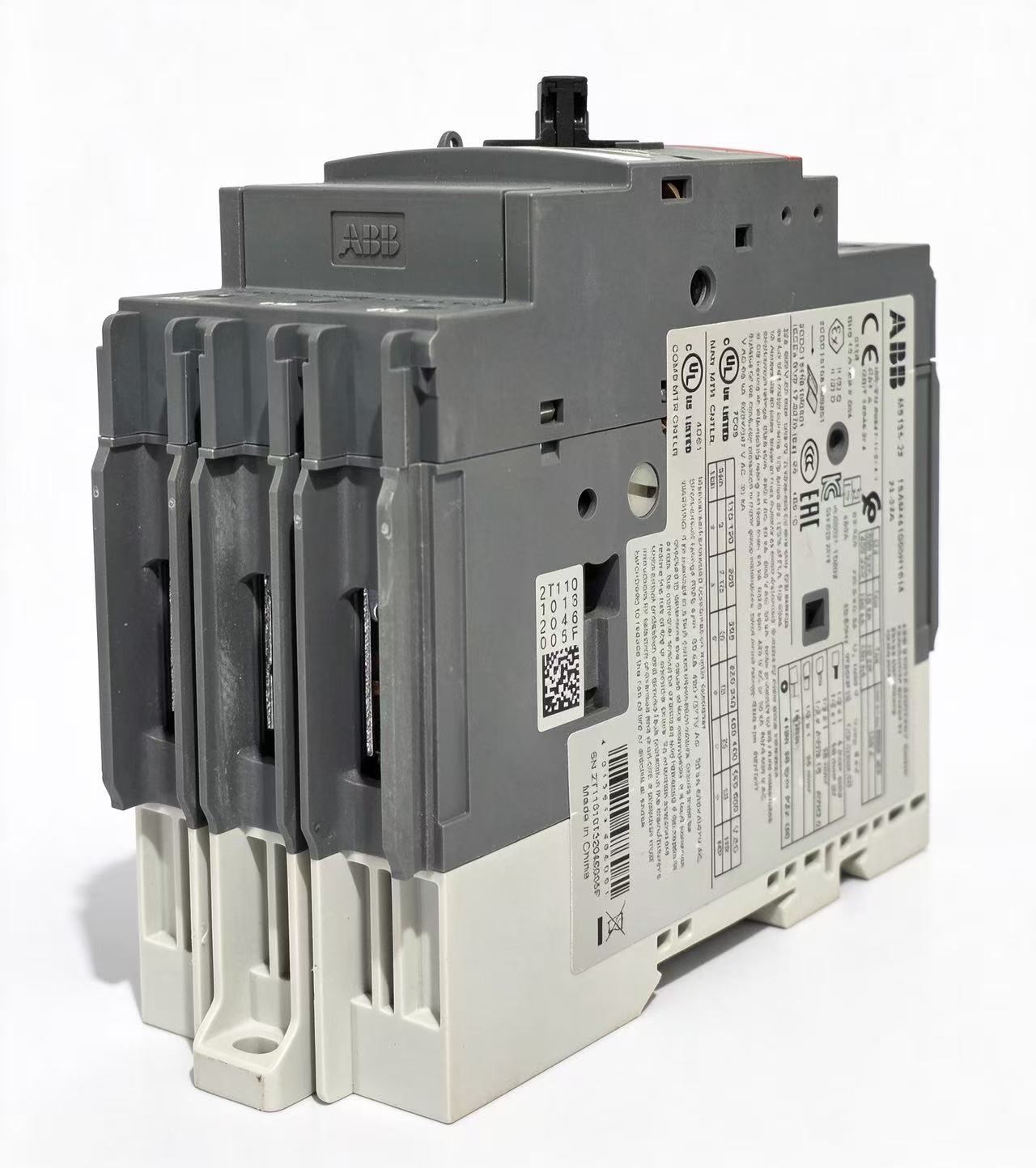
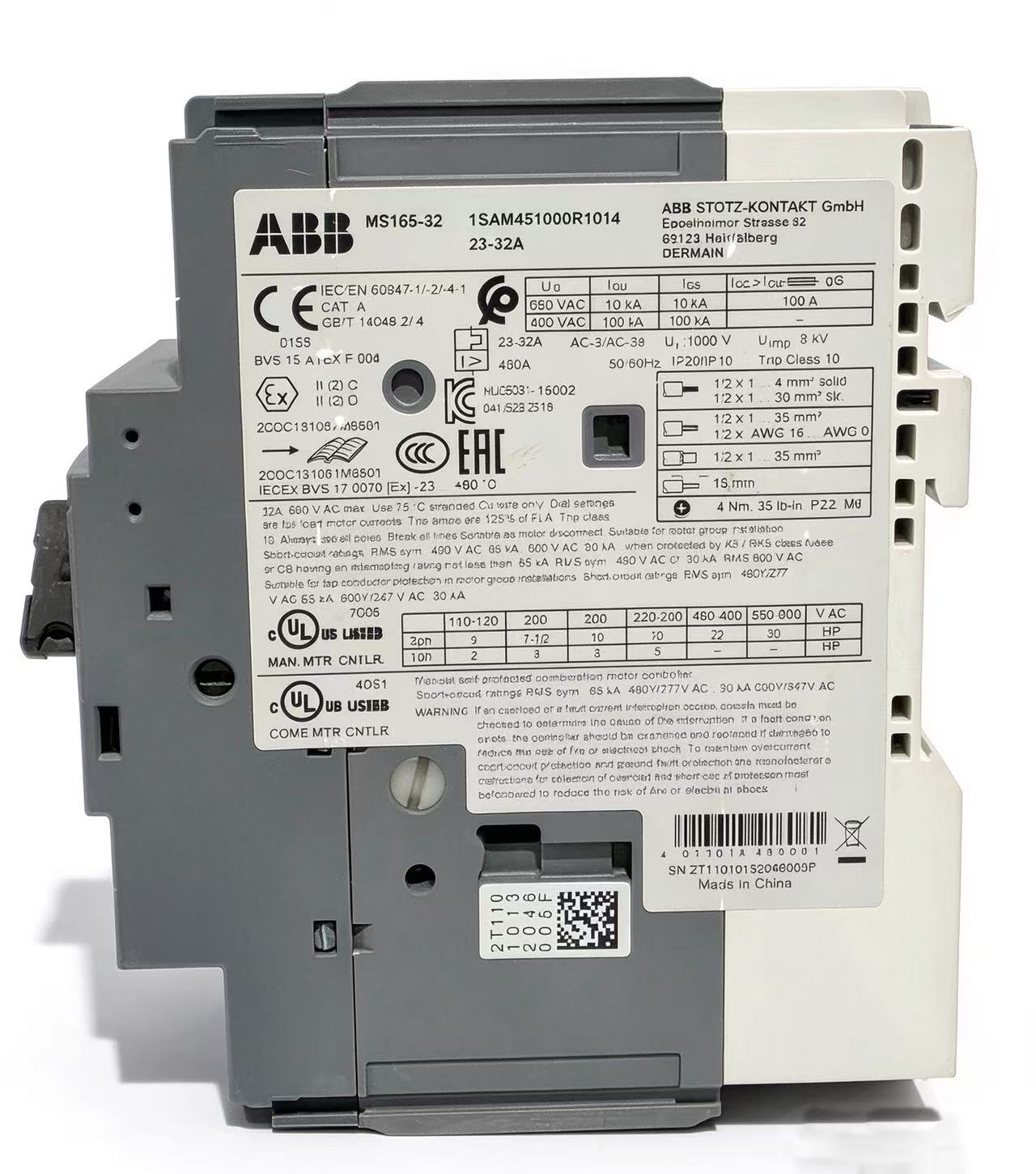
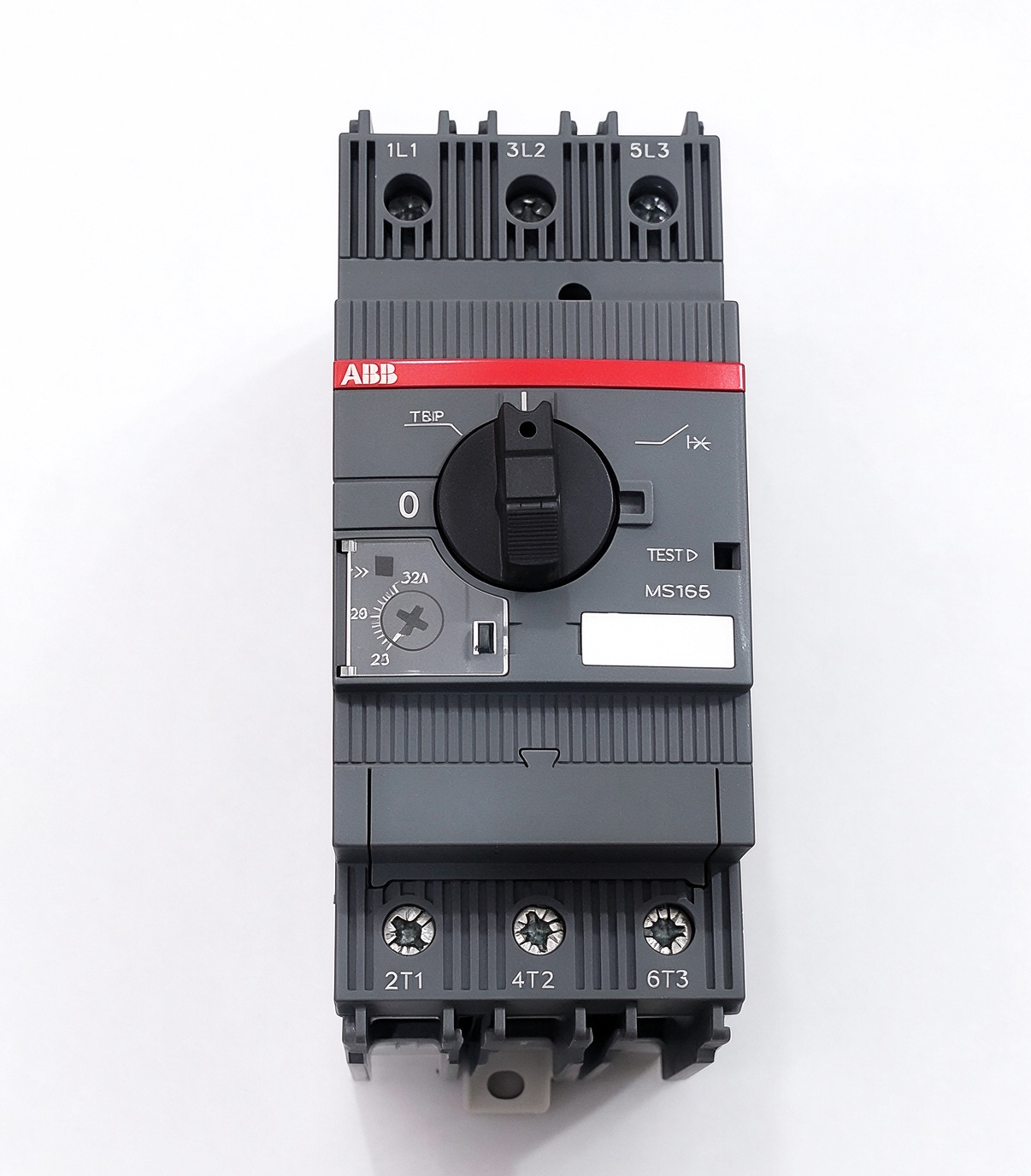
ABB 1SAM451000R1014 MS165-32 Manual Motor Starter
Product Overview
The ABB 1SAM451000R1014 is an MS165-32 manual motor starter designed for switching and protecting electric motors in industrial electrical systems. It combines manual operation with protective functions in a compact three-pole device. The adjustable current range is 23–32 A, allowing the starter to be configured according to the rated current requirements of a compatible motor and its application.
Manual motor starters are commonly installed in control panels, machine cabinets, and motor control assemblies. They provide a practical means of switching a motor circuit and responding to specified electrical fault conditions. In the ABB MS165 range, the MS165-32 model supports motor protection against overload, short circuit, and phase failure. Correct selection and adjustment are essential for coordinating the starter with the motor, supply circuit, and other control equipment.
Key Product Characteristics
- Manufacturer: ABB
- Product model: MS165-32
- Order number: 1SAM451000R1014
- Product type: Manual motor starter
- Number of poles: Three
- Adjustable current range: 23–32 A
- Trip class: Class 10
- Rated insulation voltage: 1000 V
- Rated operational voltage: Up to 690 V AC for the main circuit, subject to the applicable ratings
- Connection type: Screw terminals
- Product family: ABB MS165 manual motor starters
These characteristics help identify the device and assess its suitability for a motor protection circuit. Final selection should be based on the applicable ABB technical documentation and the electrical conditions at the installation site.
Motor Switching and Protection
The MS165-32 integrates manual switching and motor protection in one device. Its rotary handle provides a direct means of operating the circuit, while the protective mechanism responds to specified fault conditions. This arrangement can simplify the layout of motor control panels and reduce the need to combine separate devices for basic motor switching and protection functions.
Overload protection addresses situations in which a motor draws excessive current over a period of time. Prolonged overload can increase winding temperature and accelerate insulation deterioration. The current setting should therefore be selected in accordance with the motor nameplate data, the manufacturer’s instructions, and the protection coordination requirements of the installation.
Short-circuit protection addresses much higher fault currents that can occur when conductors come into unintended contact. The starter’s protective mechanism is designed to interrupt the circuit within its specified operating limits. The available fault current, system voltage, and required breaking capacity must be considered when selecting the device for a particular distribution system.
Phase failure can also create damaging operating conditions for three-phase motors. The MS165 family includes protection against phase failure. The overall protection arrangement must still be assessed against the motor characteristics and the requirements of the machine or process being controlled.
Trip Class and Current Adjustment
The MS165-32 has Trip Class 10 characteristics. Trip class describes the standardized response category of an overload protection device under defined test conditions. It is relevant when evaluating motor starting behavior and protection requirements. The appropriate selection depends on the motor’s starting current, acceleration time, operating duty, and the potential consequences of an overload.
The adjustable setting range of 23–32 A provides flexibility for applications whose motor current falls within this range. The setting must not be chosen simply from the maximum current printed on the device. Instead, the motor nameplate current and the manufacturer’s coordination guidance should be used to determine a suitable value. Where the motor experiences long starting periods or frequent starts, the complete starting and protection arrangement should be reviewed before commissioning.
Correct adjustment helps balance two objectives: allowing normal motor starting and operation while providing protection under abnormal conditions. If nuisance tripping occurs, the cause should be investigated rather than increasing the setting without checking the motor load, supply quality, wiring, and starting profile.
Operating Handle and Installation Design
The MS165-32 uses a rotary handle with a clear indication of the switching position. The operating mechanism provides a straightforward interface for authorized personnel working with motor circuits. The handle can be locked to help prevent unauthorized changes to the switching state. Locking provisions should be used as part of the site’s established isolation and safety procedures, rather than as a substitute for safe electrical work practices.
The device has a compact form factor for its protection class, with a product width of approximately 55 mm. This dimension can assist panel designers when estimating the space required for a motor starter assembly. The complete installation layout must also allow for conductor bending, terminal access, heat dissipation, clearances, accessories, and the enclosure’s environmental conditions.
Screw terminals provide the electrical connection points. Conductors must be selected and prepared in accordance with the applicable ratings and installation instructions. Tightening torque, conductor size, terminal preparation, and any requirements for ferrules or other termination accessories should be confirmed from the manufacturer’s documentation before wiring.
Industrial Applications
The ABB MS165-32 can be used in industrial motor circuits where the electrical requirements fall within its specified ratings. Typical application areas include production machinery, material handling systems, pumps, fans, compressors, and auxiliary equipment. Suitability depends on the motor’s rated current, supply voltage, starting conditions, available short-circuit current, and the control system design.
In a machine control panel, a manual motor starter may form part of a broader motor control arrangement that also includes contactors, control relays, terminal blocks, safety devices, and a programmable logic controller. The starter performs its own switching and protection functions, while other components provide functions such as remote operation, process sequencing, interlocking, and supervisory control.
For systems requiring remote start and stop commands, the panel designer should determine whether a separate contactor or additional control components are required. The manual motor starter should not be assumed to provide every control or safety function needed by the machine. The complete circuit must be designed to meet the operating requirements and relevant electrical safety standards.
Compatibility and Model Identification
ABB 1SAM451000R1014 identifies the MS165-32 model. Confirming both the complete order number and the product designation is important when replacing a device or preparing a new panel. Similar products within the MS165 family can have different adjustable current ranges, so visual similarity alone is not sufficient to establish interchangeability.
Before selecting a replacement, compare the original device’s current range, number of poles, voltage ratings, fault-current requirements, terminal arrangement, dimensions, and installed accessories. Also check whether the application requires auxiliary contacts, signaling contacts, undervoltage releases, shunt trips, or power in-feed accessories. Accessory compatibility should be confirmed against the relevant ABB documentation for the product family and device version.
When identifying a device from a label or photograph, ensure that the complete part number is legible. The model designation, electrical ratings, and accessory configuration should be recorded before ordering. This approach reduces the risk of selecting a model that fits physically but does not satisfy the circuit’s electrical or operational requirements.
Installation and Maintenance Considerations
Installation should be performed by qualified personnel with the circuit isolated and verified safe according to applicable procedures. The device must be mounted in an enclosure and environment appropriate to its specifications. Supply connections, load connections, conductor sizing, terminal torque, and protective coordination should be checked before the motor circuit is energized.
Ambient temperature can affect electrical equipment performance and current-carrying capability. The published operating range for this product is approximately -25°C to +60°C, with the applicable compensation and installation conditions defined by the manufacturer. Actual use should remain within the documented limits, taking account of enclosure temperature and adjacent heat-producing components.
During maintenance, inspect the device and associated wiring for signs of overheating, discoloration, mechanical damage, loose connections, or contamination. Investigate repeated trips by checking the motor load, phase conditions, insulation condition, supply voltage, starting time, and current setting. Protective devices should not be bypassed to keep a machine operating. If the starter is damaged or its operating characteristics are uncertain, follow the manufacturer’s instructions for assessment and replacement.
Selection Guidance
When evaluating ABB 1SAM451000R1014, begin with the motor nameplate and the electrical design of the installation. Confirm that the required current setting falls within 23–32 A and that the device’s voltage and short-circuit ratings are appropriate for the circuit. Review starting behavior, protection coordination, and the need for additional switching or signaling components.
For replacement work, compare the full order number with the installed device and verify the terminal and accessory arrangement. For new installations, consult the relevant ABB technical data and installation instructions to confirm all ratings and mounting requirements. Product selection should be based on the actual application rather than the model number alone.
Conclusion
ABB 1SAM451000R1014, designated MS165-32, is a three-pole manual motor starter with an adjustable current range of 23–32 A and Trip Class 10 characteristics. It combines manual motor switching with protection functions for overload, short circuit, and phase failure. Its rotary handle, lockable operating mechanism, and screw terminals support integration into industrial motor control panels. Correct current adjustment, appropriate fault-current coordination, and installation in accordance with ABB documentation are essential to achieving the intended protection and reliable operation.
评价
目前还没有评价