
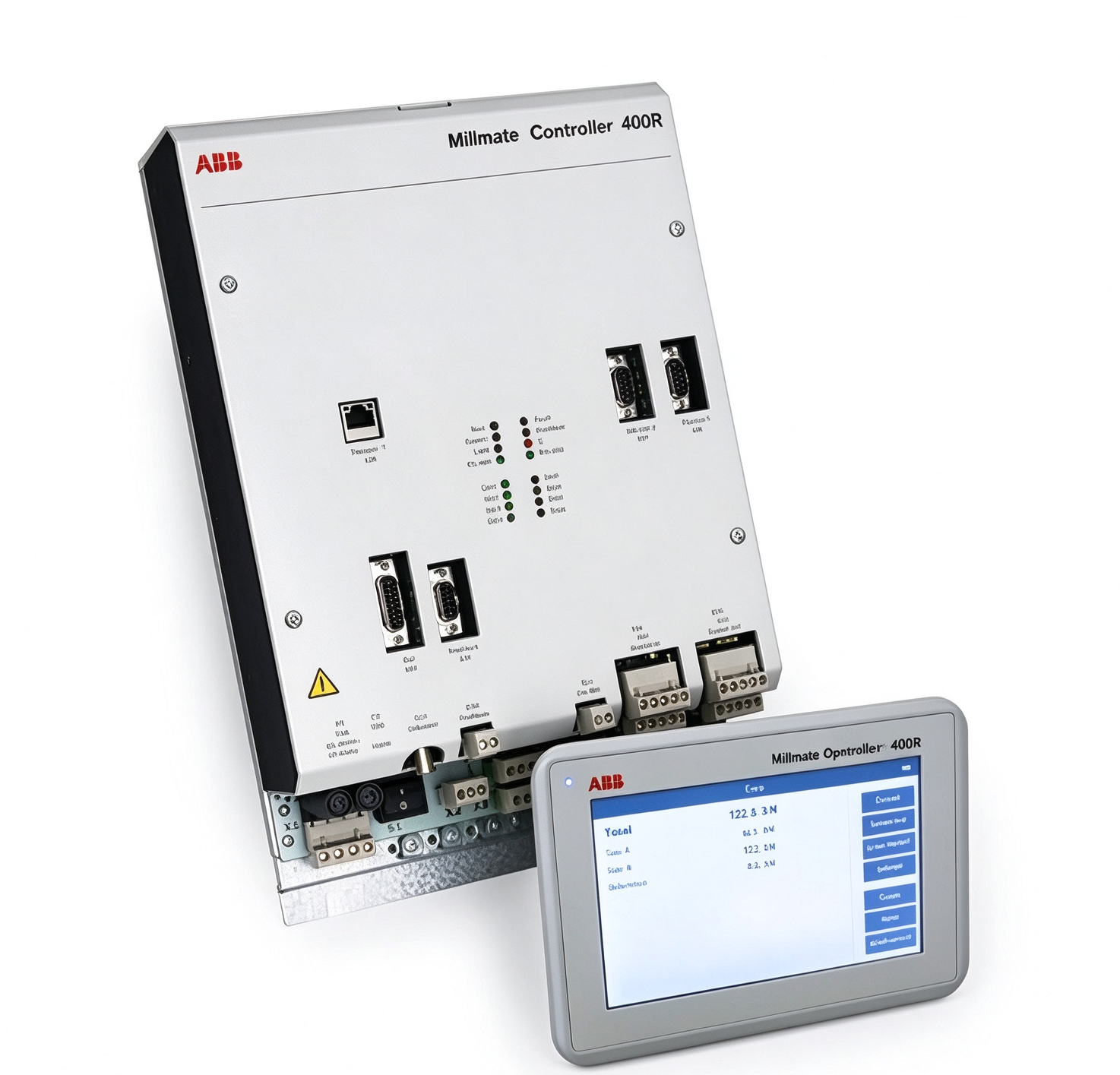
ABB MC400R Millmate Controller 400
The ABB MC400R is a product designation associated with the Millmate Controller 400 family used in industrial measurement and process-control applications. The MC 400 platform is designed to support strip tension measurement by processing signals from compatible load cells and applying configuration data that reflects the mechanical arrangement of the production line. Correct model identification is essential when selecting, configuring, or replacing this equipment.
Product Overview
Strip tension is an important process variable in metal processing and other continuous-web production applications. During rolling, winding, unwinding, and material transport, tension must be monitored to help maintain process stability and consistent material handling. Measurement and control equipment converts sensor signals into usable process information for operators and connected automation systems.
ABB’s Millmate Controller 400 is designed to support these requirements. Its documented functions include predefined measurement modes, configurable mechanical arrangements, built-in load-cell tables, selectable measurement units, and self-diagnostic functions. The controller uses the configured system information and connected transducer signals to calculate strip tension for the intended application.
The controller is not simply a general-purpose signal display. Its role is to process measurement information in the context of the mechanical setup and sensor arrangement. Accurate configuration is therefore important to obtaining meaningful results. The selected measurement mode, load-cell data, mechanical geometry, and signal connections must correspond to the actual installation.
ABB’s publicly available Millmate Controller 400 documentation identifies PFCA401 as a product model. Because the exact relationship between that documented model and the MC400R designation has not been independently confirmed, the detailed capabilities described below should be treated as product-family information until the complete MC400R part number is verified.
Strip Tension Measurement
In continuous material processing, tension affects material tracking, stability, and the interaction between different sections of a production line. Excessive or insufficient tension can contribute to process disturbances, material deformation, or inconsistent handling. A suitable measurement system provides process data that can be used by operators and control equipment to monitor these conditions.
The Millmate Controller 400 family is designed to calculate true strip tension for supported mechanical arrangements. Instead of treating the sensor signal in isolation, the controller uses information about the measurement setup to interpret the applied force. This approach helps adapt the measurement to different machine configurations.
Load cells or force transducers provide the measurement input. The controller processes the corresponding signals and uses the configured load-cell information and mechanical arrangement to derive the required process value. The accuracy of the result depends on the suitability of the sensor, the correctness of the mechanical installation, and the configuration of the controller.
For a replacement installation, engineers should confirm the existing measurement principle, load-cell type, mechanical geometry, calibration information, and wiring arrangement. Copying configuration values without checking that the hardware and mechanical setup match may lead to incorrect readings even when the controller powers up and communicates normally.
Configuration and Measurement Modes
The MC 400 platform includes predefined standard measurement modes intended to simplify setup for supported mechanical arrangements. These modes provide a structured way to configure the controller for the installed measurement system. The selected mode must reflect the actual machine layout and the position of the load cells or force transducers.
Built-in load-cell tables are another documented feature of the controller family. These tables support configuration using the applicable transducer information. The appropriate entries must be selected for the installed sensors and checked against the corresponding documentation. An incorrect sensor selection can affect the relationship between the measured signal and the calculated tension.
The platform also supports different measurement units, including N, kN, MN, kp, tonnes, pounds, and short tons as documented for the MC 400 family. Selecting the correct unit is important when interpreting displayed values, transferring data to a supervisory system, or comparing measurements with production specifications.
Filtering can be configured to suit the measurement application. ABB’s PFCA401 product information lists filter times from 5 to 2000 milliseconds. Filtering affects how quickly the displayed or transmitted measurement responds to changes in the input signal. The appropriate setting depends on the process dynamics and the intended use of the measurement. These numerical values should be verified before being attributed specifically to an MC400R unit.
Analog and Digital Signal Interfaces
The documented Millmate Controller 400 platform provides analog and digital connections for integration with external equipment. Analog inputs allow supported voltage signals from measurement or control devices to be received. Analog outputs can be used to transmit process information to compatible equipment, depending on the selected signal type and system configuration.
For the documented PFCA401 model, ABB lists two or four analog inputs, with 0 to 10 V and ±10 V differential input options. Four analog outputs are listed, supporting ranges that include 0 to ±10 V, 0 to ±20 mA, and 4 to 20 mA. The exact available channels and signal configuration should be confirmed against the actual hardware version and its connection documentation.
Digital inputs and outputs provide additional means of exchanging control signals with external equipment. The PFCA401 documentation lists eight digital inputs and eight digital outputs, arranged as two insulated groups of four. These interfaces may be used for supported control and status functions within the configured application.
When connecting a controller to an existing automation system, verify signal type, polarity, electrical reference, isolation requirements, terminal assignments, and the expected behavior of each channel. The electrical interface must be compatible with the connected PLC, drive, display, or other control equipment.
Communication and System Integration
Industrial measurement controllers commonly operate as part of a larger automation architecture. They may exchange process values and control signals with PLCs, supervisory systems, operator displays, or other connected equipment. Communication and interface options must be selected according to the actual model and the requirements of the installation.
ABB’s Millmate Controller 400 documentation describes serial interfaces for external displays and control functions. It also identifies optional high-speed PROFIBUS communication and an Ethernet connection for communication with other Millmate control or operator units and compatible control systems using the documented VIP protocol.
These capabilities can support integration into a coordinated production-line architecture, but their availability depends on the hardware and options installed. A controller should not be assumed to include every interface merely because the function appears in family-level documentation.
Before connecting a replacement unit, check the communication protocol, connector type, network settings, software compatibility, and the configuration of the receiving equipment. If a communication option is required by the project, confirm that the exact model and hardware configuration support it.
Diagnostics and Process Monitoring
The documented MC 400 family includes a self-diagnostic system with transducer testing. Diagnostic functions can help maintenance personnel investigate whether a measurement problem is associated with the sensor, signal path, configuration, or controller. The specific tests and diagnostic indications available should be checked in the manual for the installed model.
When an abnormal tension value appears, the investigation should begin with the process and measurement conditions. Confirm that the material is in the expected operating state, inspect the sensor and its mechanical installation, and verify the signal wiring. Review the controller’s measurement mode, selected load-cell data, units, and filtering settings before assuming that the controller hardware has failed.
Where process values are transmitted to other equipment, compare the controller’s local measurement with the value received by the connected system. A difference may indicate a scaling, signal-range, unit, or communication configuration issue. Troubleshooting should follow the plant’s approved maintenance procedures and the applicable product instructions.
Installation and Maintenance Considerations
Before installing or replacing an MC400R, record the complete model designation, hardware identification, available interface options, and existing wiring arrangement. Confirm the exact product identity using the equipment label and applicable ABB documentation. The model number alone may not provide enough information to establish interchangeability.
Installation should be performed by personnel familiar with the equipment and the production-line control system. Follow the manufacturer’s requirements for mounting, grounding, electrical connections, environmental conditions, and commissioning. Any changes to a running line should be assessed for their effect on process control and production safety.
After installation, verify that the configured measurement mode and load-cell data match the physical setup. Check the measurement units, signal scaling, filter settings, and connected input and output channels. If communication interfaces are used, confirm that data is exchanged correctly with the connected control or supervisory system.
Keep configuration backups, wiring records, calibration information, and maintenance notes available for future service. These records help reduce setup errors and make it easier to compare the replacement configuration with the original installation.
Industrial Applications
The Millmate Controller 400 family is intended for strip tension measurement and related process applications in industrial production lines. Typical environments include rolling mills and material-processing lines where tension information is required to monitor material handling and support process control.
Depending on the mechanical arrangement and the connected automation system, measured tension values can be used for operator monitoring, process supervision, and coordination with other control equipment. The suitability of a particular controller depends on the required measurement range, sensor arrangement, interface configuration, and environmental conditions.
Correct application engineering is essential. The measurement system must be configured for the actual mechanical setup, and the selected hardware must match the electrical and communication requirements of the installation.
Conclusion
The ABB MC400R designation is associated with the Millmate Controller 400 product family for industrial strip tension measurement and control. The documented MC 400 platform supports configurable measurement modes, load-cell integration, tension calculations, selectable units, analog and digital interfaces, diagnostic functions, and optional communication capabilities.
Because the available ABB documentation identifies PFCA401 and does not conclusively establish all specifications for the exact MC400R designation, the complete product code should be checked before publishing model-specific technical data or selecting a replacement. Confirming the hardware version, sensor compatibility, interface options, and configuration requirements helps ensure that the controller is suitable for the intended installation.


评价
目前还没有评价